
That’s way too harsh and really more about me than the book. So, let me start by saying that Ernest Hemingway’s For Whom the Bell Tolls (1940) is a fine book by almost any standard, but not the ones I apply to a writer as important and good, normally, as Ernest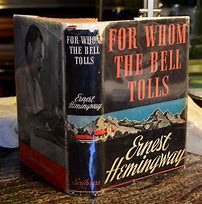 Hemingway.
This book had slipped by me for a long time and given its status in the canon and my love for Hemingway’s work, my expectations were high. So, that’s on me too. My expectations of some books I’ve put off—Beloved by Toni Morrison, The Orchid Thief by Susan Orlean, The Amazing Adventures of Kavalier & Clay by Michael Chabon—can skyrocket if I already know and like the author’s work. Add a National Book Award, a Pulitzer, or in Hemingway’s case, a Nobel Prize, to the mix and I’m pretty much expecting to be unable to sleep, eat, write, watch soccer, kiss my wife, or talk to my kids until I’m done reading the book. (That never happens, but shouldn’t it feel like it could?).
And as far as Hemingway goes, this is a very Hemingway work: war, alienated protagonist, spare prose, and a lot of strong-minded yet understated characters. We start in the mix of it too: the Spanish Civil War and an ex-pat American, Robert Jordan, who is on a mission to blow up a bridge and kill some Fascists. Sounds fun even in 2019. But despite starting the reader off in the midst of this action, the first 200 pages or so kind of drag. There’s a lot of history to learn here and Hemingway seems Hell-bent on teaching us. That would be fine if, in the current time of the story, more was happening. Sure, there is a lot of downtime in war, but this is fiction, the author’s job is to shorten the down time and fill it with really compelling characters and events. Hemingway tries, to be certain, but really doesn’t hit his stride with compelling action until the last third of the book.
If you know Hemingway and know what he is about, you expect spare prose. You don’t expect under-developed characters taking center stage at times or over-developed backstory about minor characters. It’s as though Hemingway is more concerned at times with proving he was really there and he knows the culture and the history, all at the expense of pace and a compelling story.
Ultimately, the story of Robert Jordan is compelling and there are moments of both action and interiority that take your knees out from under you. And despite the under-developed characters getting too much importance, there are still plenty of well-rounded characters, Pilar comes to mind, who deepen the read and win the day.
This is not Ernest Hemingway at his best, and I would not recommend it to anyone as an introduction the author, but it is an essential, and ultimately enjoyable, read once you know and appreciate his work. For Whom the Bell Tolls may not fail for everyone, even if it did fail for me.

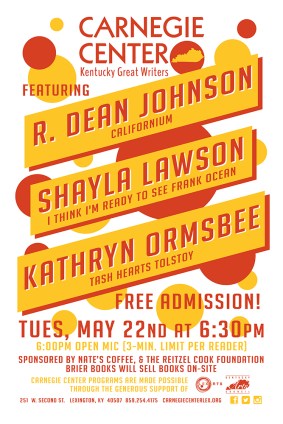 was July 5, 2016. In terms of proper premieres, this one had it all:
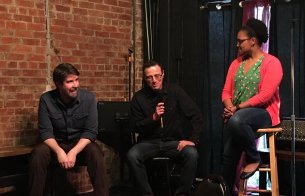 DikNixon. It’s always a pleasure to go there. But, I’m also glad to be transitioning more and more attention to finishing the next two projects—an essay collection and a novel. The former is close and the latter, who knows, but I like where it’s going so far.
 December 15.
 which you might think makes sense, one big name writer honoring another. But Denis didn’t discriminate. If you were reading, whether he knew your name or not, he was listening.
 trying to come up with a name for their punk band and running through a list of possibilities: Atomic Anarchy, Gone Fission, Second Thoughts, Screaming Mimes, The Variables, Solve for X, Los Punks, and ¿Habla Anarchy?. To my relief, people were laughing in all the right places, including Denis. After the reading, he even had a suggestion for a band name: Dowager Orgy.
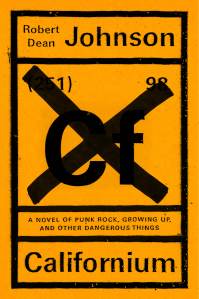
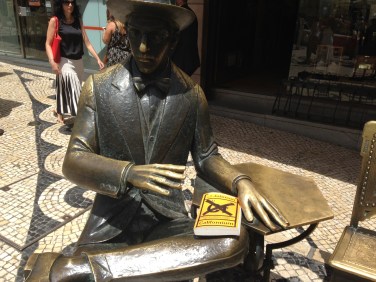 Fernando Pessoa never visited the United States, so he never made it to California. At least, not physically. A writer so ahead of his time — post-modernist before there was post-modernism — he surely would have found a novel set in a time and place beyond his own experience attractive. He would have laughed at early eighties So Cal culture (as we all should); he would have delighted in characters who are trying to understand their place in the universe (even if that universe is high school); and he definitely would have liked punk rock (in principle, and maybe in practice as well). And if nothing else, he’d have been intrigued by the cover. It’s a pretty cool cover.
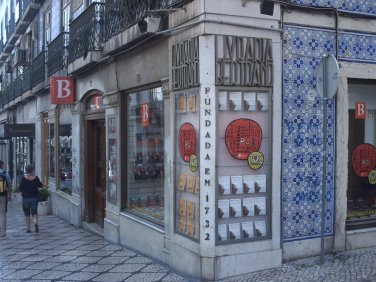 Long before I had a book deal or even an agent for my first novel, Californium, back when it was just a manuscript, I knew, well I believed, it was a book somebody would want some day. So, even then I’d think about that day Californium would be published, and where I’d be.
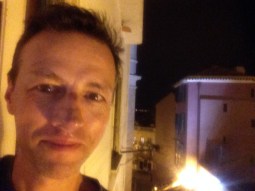 do with Portugal, or Europe, or anything historical beyond the early eighties punk scene set down amidst California’s growing military industrial complex (in a funny way, I promise). This is the third week of a teaching assignment with Disquiet International and Bluegrass Writers Studio Low-Res MFA program. I committed to it before the pub date was set.
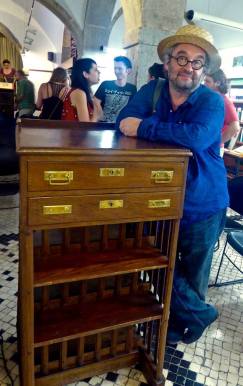 over these past few weeks, I’ve had the pleasure of attending so many other great readings around this historic city—Padgett Powell, Molly Antopol, Maaza Mengiste, John Herrin, Mikhail Iossel, Chanan Tigay, Annie Liontas, Arthur Flowers, Sabina Murray, Afonso Cruz, and National Book Award Winner, Denis Johnson (who I am blatantly name-dropping here because he came to my reading too and laughed at all the right places, which may be the most authentic kind of positive review I could ever hope for).
 You know how you sometimes hear those apocryphal stories about writers and writing: Ernest Hemingway’s wife leaving his entire manuscript on a train; Sherwood Anderson writing the bulk of Winesburg, Ohio, in the middle of the night and naked; Alice McDermott basing an uncompleted novel on one of my short stories? Some are completely false (like the thing about Alice McDermott; I just really like her). But some are based in fact and a few of those happen to be completely true.
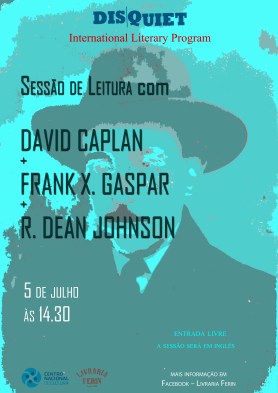
 I’m giving a “two weeks before it’s released” reading of CALIFORNIUM, which really isn’t a thing. The thing is that I’m reading with David Caplan and Frank X. Gaspar. The other thing is that the reading will be at Livraria Ferin, a bookstore in the Baixa-Chiado neighborhood of Lisbon. So, two things. Super cool things.


 This is supposed to be my 2015 writerly wrap-up. It probably should have posted a month ago. But that’s kind of what 2015 was all about. My story collection, DELICATE MEN, came out so late in 2014 (December 29) it felt more like 2015. And so, the year began with things arriving late and that never really went away.
 Also in 2015, my agent, Mackenzie Brady Watson, sold my first novel, CALIFORNIUM, to Plume-Penguin. I’d taken long gaps in working on the novel and taken a long time revising it. In fact, technically it’s the first book I ever wrote, but it will be the third book published with my name on it. (There’s a collection of pedagogical essays I edited, TEACHABLE MOMENTS, floating around this world too).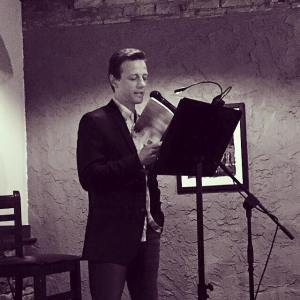

 R Dean Johnson